Redux has gained a reputation as a powerful state management tool for React and many other UI applications. While its popularity is undeniable, it's crucial to approach its usage with a discerning eye. Overuse or inappropriate application of Redux can lead to unnecessary complexity and hinder code maintainability.
To ensure effective state management, it's essential to identify the appropriate scenarios for incorporating Redux. Here's a comprehensive guide to help you determine when Redux is the right choice for your project:
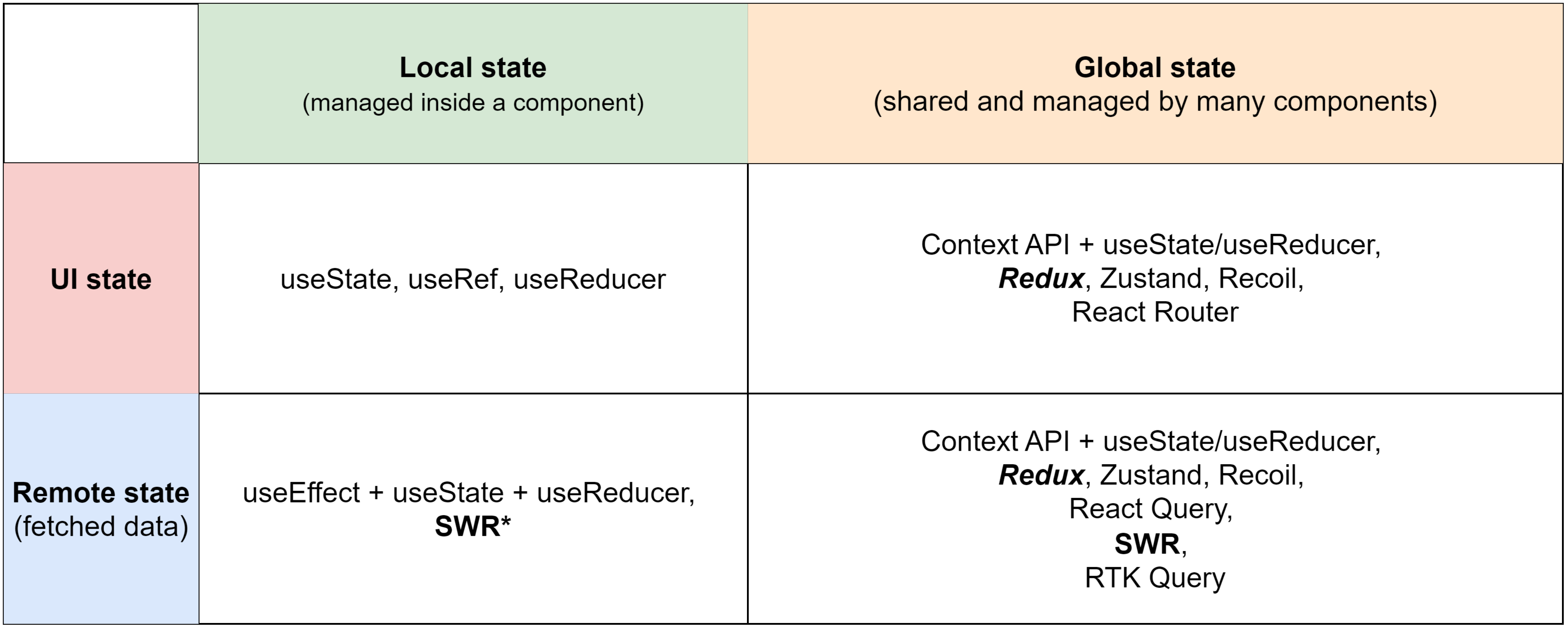
How to use different tools to manage states in React
* Check out SWR section below for more information.
While Redux has traditionally been the go-to choice for managing global state in React applications, its dominance is being challenged by newer and more efficient libraries. This shift is largely driven by the increasing prevalence of remote state, which forms a substantial portion of global state.
Why? Here're a few reasons:
Rise of Specialized Remote State Management Libraries: Libraries like SWR, and Zustand have emerged as specialized solutions for handling remote state, offering performance advantages and tailored features for dealing with asynchronous data retrieval and updates.
Complexity of Redux Setup and Configuration: Redux's rigorous unidirectional data flow and boilerplate code can bring unneeded complexity for simpler applications, especially when dealing largely with remote state.
Performance cost of Redux: In certain cases, Redux's centralized state management strategy might bring performance cost, particularly in big applications with frequent state updates.
This section is not relevant to this post topic; however, I want to mention it as I updated my knowledge. And I think this new naming convention is helpful.
In the early days of Redux, it was common practice to name actions using all-uppercase letters, such as SET_USERINFO. However, the Redux team has since recommended a shift to naming conventions that reflect the noun and verb of the state change, resulting in more descriptive and meaningful action names like user/setUserInfo.
“We recommend trying to treat actions more as "describing events that occurred", rather than "setters"...Actions should be written with meaningful, informative, descriptive type fields [...] Avoid using very generic action names like "SET_DATA" or "UPDATE_STORE", as they don't provide meaningful information on what happened..
I came across SWR by chance through Vercel's VP of Product, Lee Robinson. I gave it a try and was so impressed that I've been using it ever since for fetching data. SWR effectively supports and optimizes client-side data fetching. Some of the benefits it offers include:
Improved Performance: SWR reduces the need for frequent unnecessary re-fetches, leading to smoother rendering and a more responsive user experience.
Reduced Network Traffic: By utilizing cached data, SWR minimizes the number of requests made to the server, which can be beneficial for both performance and data usage.
Simplified State Management: SWR handles the data fetching and caching logic internally, simplifying state management within React components.
Optimistic Updates: SWR allows you to define optimistic updates, which temporarily update the UI with expected data while the actual data is being fetched. This can improve the perceived performance and user experience. Learn more here.
To be honest, SWR is so good that I find it no difficult at all to get familiar with it. For example, I can do a lot of things with just a simple line of code - which may require a lot of code doing in another way.
SWR helps avoiding a lot of boilerplates to implementing a good fetching mechanism.
Overall, SWR stands out as a powerful and user-friendly tool for managing client-side data fetching in React applications. Its ability to optimize performance, reduce network traffic, simplify state management, and provide optimistic updates makes it a valuable asset for web developers.