
5 min read
AI doesn't replace people who know how to work — it replaces the old way of working of those who refuse to evolve.
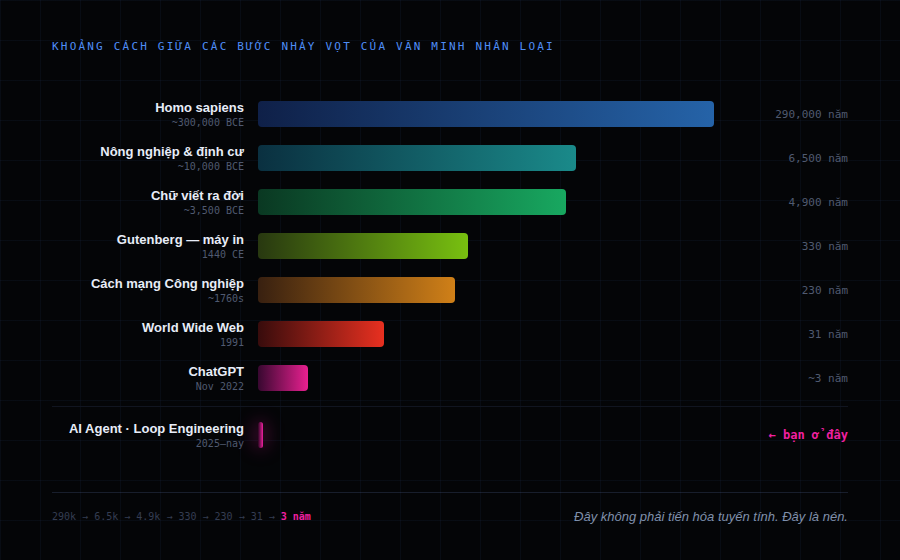
Homo sapiens appeared about 300,000 years ago.
Not until around 10,000 BCE did humans enter the agricultural era: knowing how to cultivate, breed livestock, settle down, and begin building stable communities.
Then it took another few thousand years to invent writing — the first time knowledge could exist outside an individual's memory.
Then nearly another 5,000 years for Gutenberg to bring the printing press into history — turning knowledge from something handwritten into something that could be mass-replicated.
Then a few hundred years for the Industrial Revolution to replace human muscle with steam, machinery, and production lines.
Then more than 200 years for the World Wide Web to appear — connecting human knowledge on a global network.
Then 31 years for ChatGPT to launch — and reach 1 million users after just a few days.
Then in less than 3 years, AI went from a "question-answering chatbot" into agents that can read codebases, write code, review, run tests, debug through multiple rounds, open pull requests, and change almost the entire way we work.
300,000 years → 10,000 years → a few thousand years → 5,000 years → a few hundred years → 31 years → less than 3 years.
This is not linear evolution.
This is compression.
And if you are reading this, you are living right at that inflection point.
About 4 years ago, I started using GitHub Copilot for autocomplete when it was just released. First impression: convenient, and it helped me a lot in implementing ideas.
Then ChatGPT appeared — I started chatting and applying it to more difficult problems, and asking it everything under the sun
Until recently, my friend (Truong) told me, "Thuc, download Codex and try it out..." and then.. I used Codex to delegate an entire complete and complex task.
With each step, I'm not just faster — I am delegating a part of my thinking to the machine. And I realized: I am no longer the one writing code. I am the designer of intent — as for its realization, I hand it over to AI.
That was when I began to notice a shift in how the whole industry names what is happening.
This journey is happening so fast that if you don't pay attention, you will miss every single leap forward.
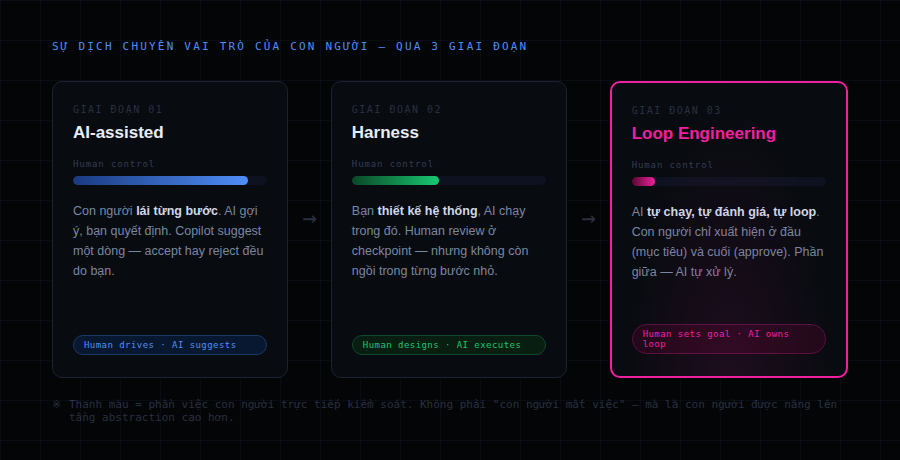
Phase 1: AI-assisted Humans still drive, AI only suggests. Copilot suggests a line, you accept or reject. You are still the decision-maker at every small step.
Phase 2: Harness You don't just use AI as a tool anymore — you frame it into a structured workflow: clear input, measurable output, humans review at critical checkpoints. AI is the engine. You are the track designer.
Harness is the first real leap forward: from "AI helping me do things" to "I design the system for AI to do things".
Phase 3: Loop Engineering But just as Harness became mainstream, another concept emerged and began to replace it.
The core difference? Harness still has humans sitting between the steps. Loop does not — or almost does not.
The agent runs autonomously, evaluates its own output, decides the next step, and loops back by itself until it meets the predefined criteria. Humans only appear at both ends: setting goals and approving final results.
Codex runs an entire feature branch. Cursor Agent self-debugs through multiple rounds. Tools like Antigravity are pushing the boundaries even further — autonomous loops without a human-in-the-middle.
X / TwitterGreg Brockman - President & Co-Founder @OpenAI
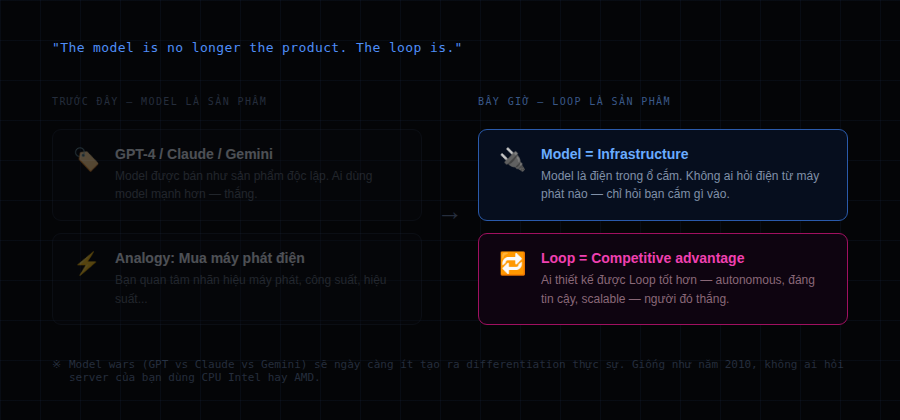
GPT, Claude, Gemini... — they are gradually becoming electricity. You don't buy electricity because of the generator's brand name. You buy it because of what the thing you plug into that socket creates.
The model is infrastructure. What creates real value — is the Loop you build around it.
What does this mean for developers, for builders, for those who use AI every day?
It means that competitive advantage no longer comes from knowing how to prompt better or using a more powerful model. It comes from designing a good enough Loop — a system where AI can run autonomously, reliably, and can scale within it.
I didn't write this article to hype AI or to scare you about the future.
I wrote it because looking back at that timeline — 290,000 years, then 6,500 years, then 330 years, then 3 years — I see a very clear pattern: every time civilization leaps forward, not everyone gets swept away. But those who proactively adapt early are always the ones who shape the next layer.
Gutenberg didn't eliminate people who love the written word — he created a new class: editors, publishers, journalists.
The Industrial Revolution didn't wipe out labor — it created hundreds of new occupations that did not exist before.
The Internet didn't kill journalism or books — it created bloggers, YouTubers, podcasters, and an entire creator economy.
AI agents and Loop Engineering will be no different. The question is not "will it change everything?" — the answer is obviously yes. The real question is:
Will you be the one getting swept away, or the one designing the Loop?
- Homo sapiens ~300k years — Nature: https://www.nature.com/articles/nature.2017.22114
- Agriculture / domestication — Britannica: https://www.britannica.com/topic/agriculture/How-agriculture-and-domestication-began
- First writing — Britannica: https://www.britannica.com/question/Where-did-writing-first-develop
- Johannes Gutenberg — Britannica: https://www.britannica.com/biography/Johannes-Gutenberg
- First website public 8/6/1991 — Wired: https://www.wired.com/2011/08/world-wide-web-20-years
- ChatGPT launch 11/30/2022 — OpenAI: https://openai.com/index/chatgpt/
- ChatGPT reached 1 million users in 5 days — Sam Altman/X: https://x.com/sama/status/1599668808285028353
- GitHub Copilot coding agent / cloud agent — GitHub Docs: https://docs.github.com/en/copilot/concepts/agents/cloud-agent/about-cloud-agent
- Google Antigravity agentic development platform — Google Developers Blog: https://developers.googleblog.com/build-with-google-antigravity-our-new-agentic-development-platform/